
Most website projects that go wrong do not fail during development. They fail in the first week, when nobody wrote down what the site was supposed to do. The designer guesses, the owner reacts, and three rounds of revisions later everyone is tired and the budget is gone.
A website brief is a short document that prevents most of this. It does not need to be fancy. One or two pages is enough. If you are a shop owner, clinic, school or startup in Birgunj or anywhere in Nepal and you are about to hire a web developer or agency, writing a brief first is the cheapest way to get a better site and a fairer quote.
This guide walks through what to put in a website brief, in the order that works best, with a template you can copy.
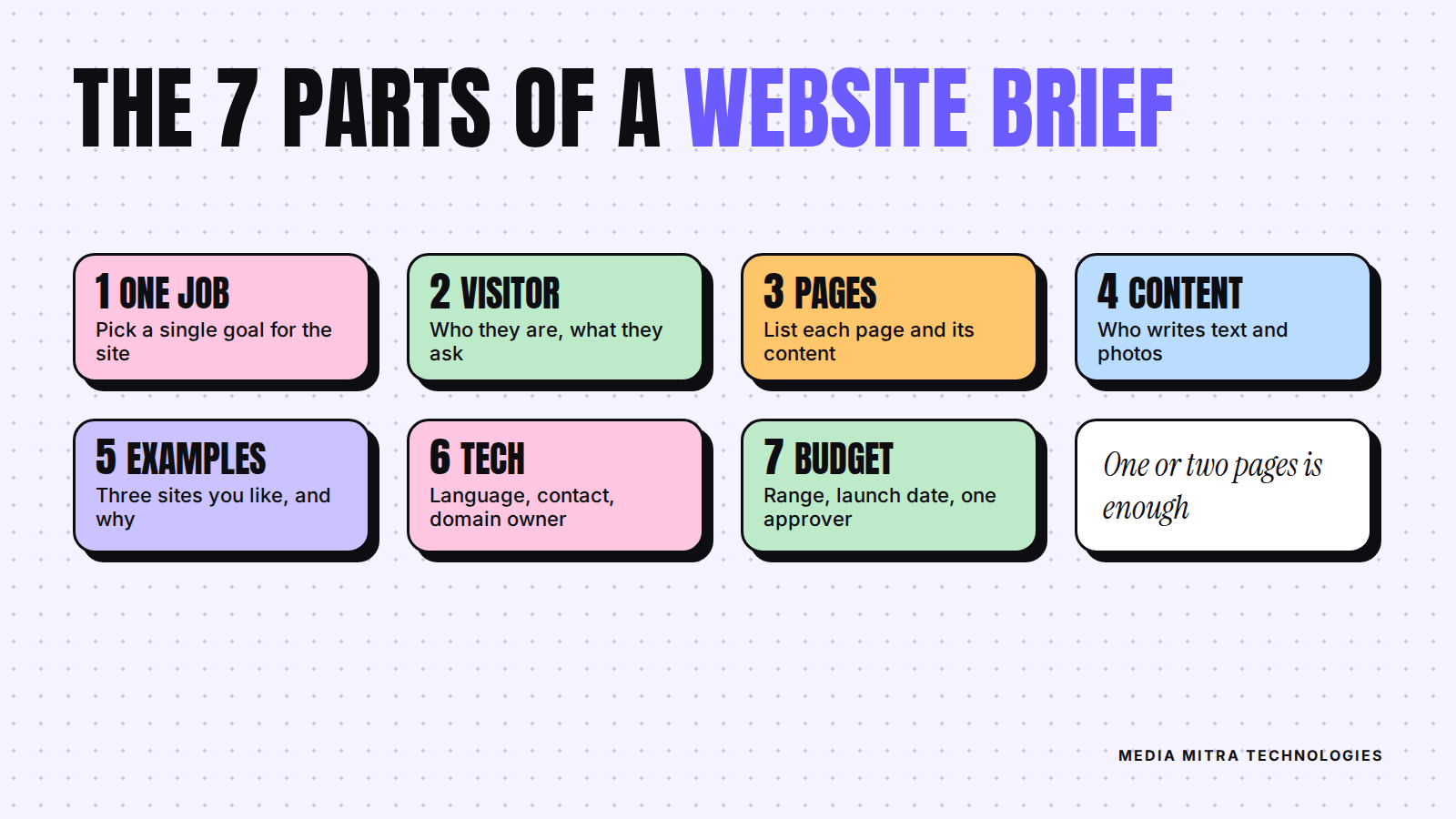
Why a website brief matters more than the design
When you tell a developer "I want a modern website", you have told them almost nothing. Modern for a jewellery store and modern for a logistics company look completely different. Without a brief, the developer fills the gaps with their own assumptions, and you only discover the mismatch when you see the first draft.
A brief helps in three practical ways:
- Quotes become comparable. If you send the same brief to three agencies, you can compare like with like instead of guessing why one quote is double another. If you want a sense of what drives price, our guide to website cost in Nepal explains the main factors.
- Revisions drop. Most endless revisions come from decisions that were never made: which pages, which tone, which photos, who approves.
- You find out what you actually want. Writing it down forces choices. Many owners realise halfway through that they care more about getting WhatsApp enquiries than about a fancy homepage animation.
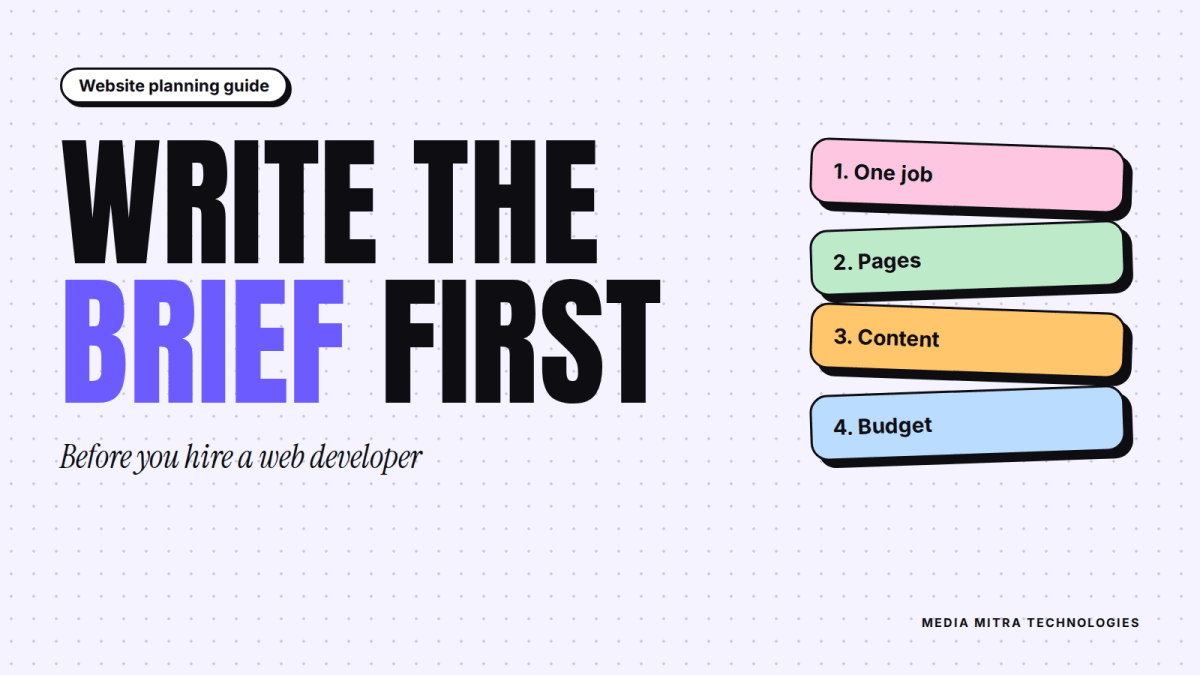
Step 1: State the one job of the website
Start with a single sentence: what should this website do for the business in the next 12 months? Pick one primary job.
Good examples:
- Get people in Birgunj to call or message us to book a service.
- Let wholesale customers browse our product range and request a quote.
- Build trust with parents so they visit the school and apply.
Weak examples: "Look professional", "Be on the internet", "Show everything we do". Those are side effects, not jobs.
Then add up to two secondary jobs. If you list ten goals, the site will do none of them well. This is also the first place to check whether you need a website right now or whether social media should come first. Our article on website vs social media for a Nepali startup can help you decide.
Step 2: Describe who the visitor is
Write a short description of your most likely visitor. Not a marketing persona with a stock photo, just a few plain lines:
- Who are they? (A homeowner comparing interior designers, a restaurant buyer, a student's parent.)
- What device are they probably using? In many Nepali towns the honest answer is a mid-range Android phone on mobile data, so your site must work well there.
- What do they want to know before they contact you? Price range, location, opening hours, samples of past work, delivery area.
- What makes them hesitate? Trust, price, distance, not knowing how the process works.
This one paragraph shapes the page structure more than any design trend does.
Questions visitors ask that your site should answer
Make a list of the ten questions customers ask you most often on the phone or in DMs. Each one should be answered somewhere on the site. If you keep answering the same question by message every day, that is a content gap.
Step 3: List the pages and what each one must contain
Do not say "five pages". List them. For a typical local business, a starting point looks like this:
| Page | What it must contain |
|---|---|
| Home | One clear promise, main services, proof, a visible contact button |
| Services or Products | Each offering with a plain description, and price or "starting from" where sensible |
| About | Who is behind the business, how long you have operated, your location |
| Gallery or Portfolio | Real photos or past work, not stock images |
| Contact | Phone, WhatsApp link, map, address, hours, enquiry form |
Add anything specific to your business: a booking page, a catalogue, an admission form, a blog. For each page, write two or three bullet points on what it needs to say. You do not need the final text yet, but you do need to know who is responsible for writing it.
Step 4: Decide who provides the content
Content is the number one reason websites launch late. Agencies often wait weeks for photos and text that the client promised to send "tomorrow".
Put this in the brief explicitly:
- Text: Will you write it, or do you want the agency to write it? If the agency writes it, who checks facts such as prices and addresses?
- Photos: Do you have good photos of your shop, products, team or work? If not, budget for a photo session. Real photos of a real place usually build more trust than generic images.
- Logo and brand colours: Do you already have them, in an editable file? If not, say whether you want branding included. Our team also does branding and graphic design, so it can be bundled.
- Deadlines for each side: For example, "Client sends all text and photos within 10 working days of kickoff."
Step 5: Give three reference websites, and say what you like
Pick three websites you like and, more importantly, write why. "I like how quickly you can find the phone number." "I like the big photos." "I like that the prices are visible." Also add one site you dislike and say why.
Avoid asking for an exact copy of a competitor or a big international brand. You want the same clarity, not the same pixels. Reference sites are about direction, not duplication.
Step 6: Note the technical and practical requirements
You do not need to be technical, but a brief should answer these questions so the quote covers them:
- Language: English only, Nepali only, or both? Bilingual sites need more planning for layout and content.
- Mobile first: State that the site must work well on small Android phones and slower connections.
- Contact methods: WhatsApp button, click to call, enquiry form, email notifications. Say which ones you want and who receives the messages.
- Domain and hosting: Do you already own a domain name? Who will own the accounts? Insist that the domain and hosting are registered in your business name or under your control.
- Ability to edit: Do you want to update text, prices or photos yourself? If yes, say so, because it affects how the site is built.
- Payments or ordering: Only if you truly need it at launch. Online payment adds work, so decide whether it is phase one or phase two.
- Search visibility: Ask that basics such as page titles, descriptions, fast loading and a Google Business Profile link are included. See our guide to local SEO in Nepal for what matters most.
Step 7: Set budget, timeline and approval process
Many owners avoid sharing a budget because they fear being overcharged. In practice, giving a range lets an agency propose the right scope instead of guessing. If the budget is tight, a good agency will tell you what to launch first and what to add later.
Also write down:
- Target launch date, and whether there is a hard deadline such as a festival season or an opening.
- Who approves. One person with decision power is better than five people with opinions. Projects slow down when a brother, a cousin and a manager all request different changes.
- Revision rounds included. Agree on how many rounds of changes are covered and how extra work is billed.
- After launch: Who handles updates, backups, security and small fixes? Ask for this to be quoted separately and clearly.
A simple website brief template you can copy
Paste this into a document and fill it in:
- Business name, location, what we sell
- The one job of the website
- Our main visitor and what they want to know
- Pages needed and what each must contain
- Content: who writes the text, who provides photos, logo status
- Three websites we like, and why; one we dislike, and why
- Languages, contact methods, editing needs, payments
- Domain and hosting ownership
- Budget range, launch date, single approver
- What happens after launch
Common mistakes to avoid
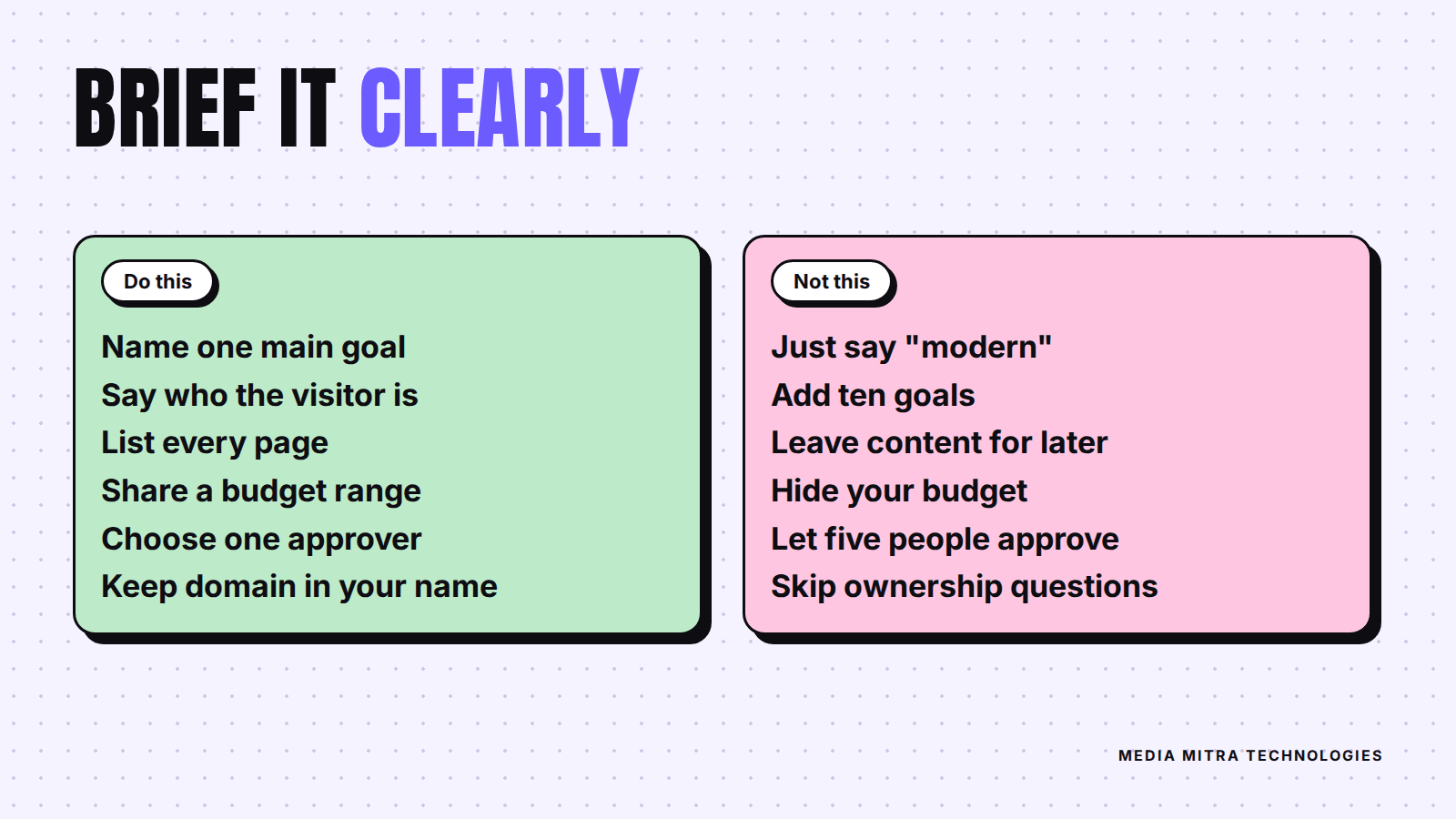
- Writing a brief that is all about looks. Colours and animations matter less than whether visitors can find your phone number in five seconds.
- Listing every feature you have ever seen. Each feature adds cost and delay. Start with what supports the one job.
- Skipping the content plan. A beautiful empty template is still empty.
- Not asking about ownership. Make sure you receive login details for your domain, hosting and site admin at handover.
- Changing the goal midway. If you switch from "get enquiries" to "sell online" in week three, expect a new quote.
Frequently Asked Questions
How long should a website brief be?
One to two pages is enough for most small businesses. Clarity matters more than length. If you cannot explain the goal in one sentence, spend more time on that before contacting anyone.
Do I need to know technical terms to write a brief?
No. Describe what you want the visitor to be able to do, in plain language. A good agency translates that into technical decisions and explains them to you.
Should I include my budget in the brief?
Yes, a range is helpful. It saves time for both sides and leads to proposals that fit your reality. You can still negotiate scope.
What if I do not have photos or a logo yet?
Say so in the brief. The quote can then include a photo session or basic branding, or you can plan to launch with a simple version and improve it later.
Can I send the same brief to several agencies?
Yes, and you should. It makes the quotes easier to compare. Judge them not only on price but on how well each one understood your goal and how clearly they explain what is included.
Conclusion
A good website starts before any design work. If you know the one job of the site, who it is for, which pages it needs, who provides the content and what you can spend, you have already done the hardest part. Everything after that becomes faster and cheaper.
If you would like help turning your ideas into a clear brief, or want a quote based on one, talk to the Media Mitra team. We are happy to look at your plan and tell you honestly what to build first.